
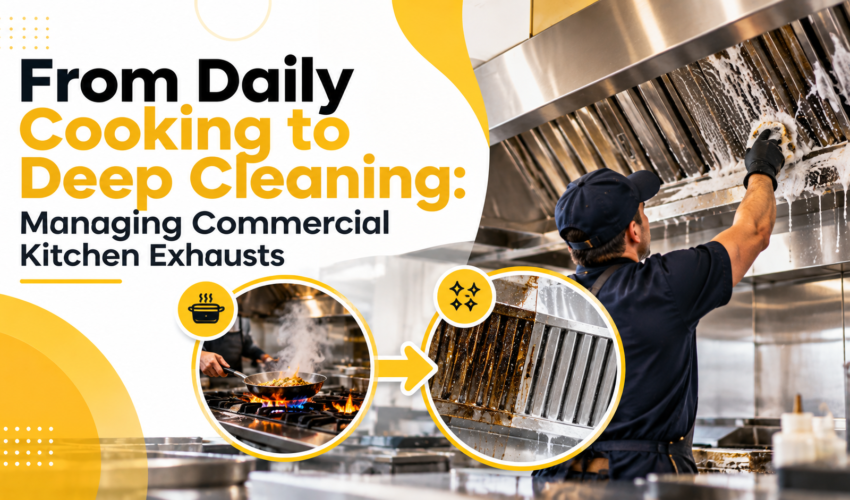
The commercial kitchen exhaust system consists of hoods, exhaust fans, filters and ductwork and maintaining them all is very important to ensure continuous kitchen operations, fire safety, and regulatory compliance. When you cook in the kitchen, you know that there will be intense heat, grease vapors, smoke and moisture in the environment. Now imagine, how it would look like in a commercial kitchen. All these contaminants get into the exhaust system hindering its performance and raising utility bills. This is where you need to hire experts who can provide commercial kitchen duct cleaning services following NFPA & IKECA Standards.
Envirox offers commercial kitchen exhaust and extraction system cleaning services in Dubai. Our cleaning methodologies follow NFPA 96 and ANSI/IKECA industry standards and practices.
Why Commercial Kitchen Exhaust Systems Need Ongoing Attention
Installing the exhaust system will ensure that all the smoke and heat gets properly sucked inside. But if you want it to perform to its optimal capacity you need to ensure that it is clean from inside. The smoke and grease has to go somewhere, right? Especially with continuous mass cooking. Even if you clean the kitchen from the outside, the kitchen exhaust system’s insides will have serious grease buildup. It is not just the ugliness that is the problem with greasy kitchen ducts – all that buildup turns into a genuine fire hazard if left unaddressed.
IKECA specifically identifies grease and particulate accumulation within kitchen exhaust systems as a fire hazard and notes that incomplete cleaning can leave significant fire risk. Dubai Civil Defence has noted that exhaust cleaning is a compliance matter as well. Kitchen duct cleaning is an important part of a commercial kitchen’s overall fire prevention and life-safety program.
How Often Should Kitchen Duct Cleaning Be Done?
Kitchen ducts should not be allowed to accumulate excessive combustible grease deposits.
NFPA 96 standards also talk about inspection frequencies based on the type and intensity of cooking operations. IKECA has published a guidance that talks about the NFPA 96 inspection schedule where more frequent inspection for high-volume cooking operations.
The cleaning frequency will depend on the cooking process, equipment used for cooking, operating hours, fuel type, grease production and applicable local requirements. Rather than an arbitrary annual cleaning schedule, this is what you should be focusing on.
What Happens to an Exhaust System During Daily Kitchen Operations
Depending on what type of commercial kitchen you run, the amount of grease that’s absorbed by the system can vary. You could be running a kitchen where there will be a lot of grilling and frying, or only at just a moderate level. And depending on the intensity, the build up will happen. The exhaust hood will suck all the grease particles, smoke and vapour out of the kitchen whenever the burner’s lit or a fryer’s running. The grease can condense on the hood surface and it can also travel further into the ductwork before settling.
How Grease, Smoke, Vapours, and Cooking Residue Build Up Over Time
Over time and with the frequency of frying and grilling, all the grease and the smoke will move through the ductwork. It will stick to the interior surfaces and stay there. After a few weeks, more grease will be added onto it and this creates a layer that thickens gradually. Eventually, this would affect the airflow, especially around bends and joints.
NFPA 96 – The Essential Commercial Kitchen Ventilation & Fire Safety Code
NFPA 96 is the Standard for Ventilation Control and Fire Protection of Commercial Cooking Operations. This is something commercial kitchen operators, designers, maintenance staff, fire officials and insurance agents are familiar with. This standard talks about commercial cooking ventilation and fire protection.
It emphasises on the proper cleaning methods for inspection and cleaning of ventilation system along with grease removal and fire protection.
Importance Of Following IKECA Standards
National Kitchen Exhaust Cleaning Association (IKECA) establishes certain consensus standards that the commercial kitchen exhaust cleaning industry is expected to follow.
IKECA standards are based on the following cleaning protocols and are compatible with NFPA 96:
● Kitchen exhaust cleaning
● Kitchen exhaust inspection
● Kitchen exhaust system maintenance
IKECA’s current standards framework includes:
ANSI/IKECA C10-2021 – Procedures for Cleaning Commercial Kitchen Exhaust Systems
ANSI/IKECA I10-2025 – Inspection Procedure for Commercial Kitchen Exhaust Systems
ANSI/IKECA M10-2023 – Commercial Kitchen Exhaust System Maintenance Procedure
Kitchen extraction cleaning is NOT cleaning! It is a technical fire-safety service.
The Difference Between Routine Kitchen Cleaning and Exhaust System Cleaning
Wiping down a hood exterior and changing grease filters is routine kitchen maintenance. You must do that. But that is different from a full exhaust system clean. Experts that provide proper kitchen hood cleaning services in Dubai will go deeper into the ductwork and clean all the buildup. This is much more than just wiping with a towel or changing filters. This is actually how you make your kitchen spotless.
Which Parts of a Commercial Kitchen Exhaust System Need Attention?
All the components within the exhaust system will need a complete clean:
- Grease filters
- Ductwork running from the hood to the fan
- The hood interior
- Exhaust fan itself
- Fan housing
How Cooking Volume and Kitchen Operations Affect Exhaust Cleaning Needs
NFPA 96 is the internationally recognised standard for commercial kitchen ventilation and fire protection. According to this standard, the cleaning frequency is based on cooking type and volume. So what would be suitable for your commercial kitchen may not be so for a kitchen with moderate level frying. If your kitchen runs 24 hours and has heavy charbroiling and wok cooking, then cleaning every 3-4 months would be ideal. Anything less than can be attributed to a twice a year clean. It is the usage that counts so if yours is a low-volume or seasonal kitchen, you can go for a full-year without cleaning.
What Can Happen When Grease and Residue Are Allowed to Accumulate
Grease buildup can lead to commercial kitchen fires! Accumulated grease inside a duct will be exposed to heat and open flame and this will not only affect the air quality of the kitchen, but acts as an easy trigger for fires.
How to Recognise When a Commercial Kitchen Exhaust Needs Deep Cleaning
Here are some signs that indicate the necessity for hiring kitchen duct cleaning experts:
- Visible grease dripping from the hood or filters
- A drop in how well smoke clears during busy service
- Burnt or rancid smell around the exhaust area
What a Professional Kitchen Duct Cleaning Service Involves
When you hire experts for the duct cleaning services:
- The work begins with an inspection of the kitchen duct to determine the extent of buildup
- They will then proceed to clean the hood, filters, ductwork and fan
- Use specialised tools to strip the grease back
- Checking the work once it is done to ensure it meets fire safety compliance and insurance requirements
- Delivery of work report
How Regular Maintenance and Deep Cleaning Work Together
Daily and weekly staff cleaning of visible surfaces and filters keeps a kitchen looking presentable. This is not a replacement, but rather complements scheduled professional cleaning of the ductwork and fan system. Routine cleaning will catch some amount of grease, but it won’t be able to remove all of it. It is only when you do deep cleaning will the real cleaning happen.
Benefit Of Hiring Envirox for Commercial Kitchen Duct Cleaning
At Envirox, we specialise not in just the visible hood and filter cleaning, but provide a deep cleaning that will reduce fire risk and keep your kitchen compliant. We do the cleaning for both restaurants and larger commercial kitchens and yes, the cleaning frequency varies. We recommend cleaning the kitchen duct on the basis of actual cooking volume. Our team will first do an assessment before suggesting the cleaning frequency for your kitchen.
Technical Components of a Commercial Kitchen Extraction System
Here are the technical components involved in commercial kitchen extraction system and why they need to be cleaned:
1. Kitchen Extraction Hood
The cooker hood absorbs grease laden heat, smoke and vapours into it.
Cleaning: The hood has to be clean enough to be able to effectively catch and contain cooking impurities.
2. Grease Filters
Filters are used to capture the grease particles in the exhaust stream and prevent them from entering the duct system.
Heavy pollution can detract from the operation of a filter, increasing the resistance of the device to flowing air.
3. Plenum
The plenum is the space located behind or above the grease filters into which the extracted air is delivered to the ductwork.
This area is no exception to being prone to collecting grease and should not be ignored while cleaning.
4. Exhaust Ductwork
The ductwork takes the greasy laden air from the kitchen to the exterior exhaust. This is where fire-safety issues arise because the grease deposits will build up on the internal duct wall.
5. Exhaust Fan
Fan blades can accumulate grease. This will affect its mechanical performance and airflow. That is why it should be included in a comprehensive and properly scheduled exhaust-system inspection and cleaning plan.
6. Exhaust Discharge
The last air exhaust point discharges the accumulated greasy air outside the building. This should be thoroughly cleaned because the discharge area is noted for contamination and grease build-up.
Envirox Kitchen Extraction Cleaning Methodology
Our cleaning ensures totally removal of grease and oil because we do not just focus on the hood, but on the cleaning of the entire system
We locate the source of the grease and oil build up while following fire-safety and safe cleaning protocols. The following is the methodology that we follow:
- Pre-Cleaning Inspection
Our technical team assesses the following parts in the kitchen duct work to employ the best cleaning approach:
● Hood configuration
● Cooking appliances
● Grease filters
● Plenum
● Ductwork
● Access panels
● Exhaust fan
● Fan housing
● Roof-level components
● Existing grease accumulation
● Accessibility and safety requirements
Access & Safety Preparation
The entire kitchen duct exhaust system and associated equipment are prepared for safe access and cleaning. We follow the cleaning methodology highlighted in NFPA-related guidance including fan shutdown/lockout, PPE, removal or protection of equipment.
- Grease & Carbon Deposit Removal
Removal of grease and oil deposits using mechanical and chemical cleaning methods of.
● Manual scraping
● Mechanical agitation
● Degreasing
● Pressure washing
● Hot-water cleaning
● Steam cleaning
● Combination cleaning methods
Duct Cleaning
Cleaning accessible ductwork sections with grease and combustible build-up.
Exhaust Fan Cleaning
Thorough cleaning of the exhaust fan blades and accessible fan housing. Checking for any signs of high contamination, mechanical damage or other physical defects.
Filter Cleaning
The grease filters are removed, degreased and cleaned completely before they are placed.
Final Inspection
An important part of our commercial kitchen duct cleaning is to check whether the agreed scope of cleaning has been achieved and that all accessible areas have been cleaned to the cleanliness level specified.
We will also share documentation and pre/post photos for your perusal.
We promise that all our cleaning methods adhere to the NFPA 96 and ANSI/IKECA standards.
Conclusion
A commercial kitchen exhaust system will work optimally only when it is kept clean. The grease, smoke and moisture build up must be removed for your kitchen to maintain its compliance. If your kitchen’s exhaust system needs a proper cleaning, get in touch with Envirox today!