
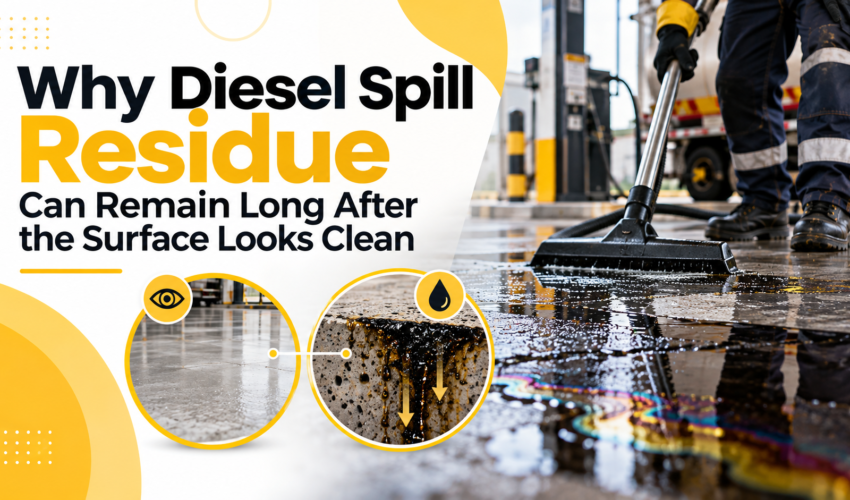
When a diesel spill happens in your building, the first instinct would be to remove the puddle, wipe the floor and hose everything. On the outside everything looks normal again. But has it become really normal? This is because diesel doesn’t behave the way water does. The floor is actually not clean and the problems almost always happen below the surface, and not on it. This is where you need to hire experts specializing in diesel spillage cleaning service.
Why a Diesel Spill Can Look Clean Before It Is Actually Clean
Diesel is oil-based and it won’t be thus easily wiped away. And when it comes into contact with anything porous, it will start working its way downward almost right away. So when you wipe and mop, you are only cleaning the top layer. Underneath the floor, the soaked in diesel is still there. This can be removed only using professional sucking methods.
How Diesel Behaves When It Spreads Across Different Surfaces
Diesel behaves differently on different surfaces:
On tiled floors – the diesel closer to the top will stay put, so cleaning actually becomes easier.
On bare concrete and unsealed flooring – the diesel gets absorbed quickly and so the cleaning has to be elaborate.
Thus the surface type alone changes both how far it spreads and how much work it takes to actually get it all out.
Why Porous Materials Can Absorb Diesel Below the Surface
Even though concrete looks solid, it really is not. There will be lots of tiny gaps and channels that liquid soaks into, and diesel is no different. The longer a spill sits on the floor or surface, the harder it will be clean it yourself. Because the diesel will really work its way into the pores. That is why it is important to call experts who specialize in chemical spillage cleaning service.
How Oily Residue Can Remain After the Visible Spill Has Been Removed
Even if you use a mop and water and detergent, you will soon find out that it will not do much against oil on a porous surface. This is because oil already has made its way into the surface. Diesel and water don’t mix, that’s why cleaning with water will not help because diesel residue will only get spread farther. Experts leave a degreasing agent on the surface as part of their cleaning services. When left for sometime, this agent will break down hydrocarbons in the diesel, making the spillage clean up effectively.
Why Diesel Odour May Persist After Surface Cleaning
It is not easy to remove odor because that is often the last to go away. If the smell’s still there after you have cleaned the area, then the cleaning was not done properly. Even when the area looks completely fine when you look at it. Cleaning experts often solve that problem by cleaning thoroughly through a process known as bioremediation. Through specialized live microbes, which are actually bacteria, the deeply embedded diesel molecules will be digested by these microbes. And that’s how the area becomes completely odorless.
The Risk of Residue Spreading to Nearby Areas and Materials
It is very important to remove all traces of diesel once the spill happens because leftover residue can get to nearby materials over time. This means – a spill that started in one small spot is now in a much wider area. That is why it has to be fully dealt with the first time.
Why Different Surfaces Require Different Diesel Spill Cleaning Methods
So it goes without saying that when there is diesel or chemical spillage, the cleaning should be aligned with the character of the floor material. Using industrial-grade, non-polar solvents or heavy-duty emulsifiers usually responds well to a sealed and non-porous flooring. Bare concrete or asphalt often needs a poultice method that slowly draws residue back out of the pores over time. This could be a slower method, but highly effective. But when the diesel gets spilled into the soil, it becomes more of an environmental containment problem than a normal surface clean. Cleaning companies with knowledge of chemical spillage, specifically diesel expertise can help solve the problem.
How Professional Cleaning Identifies and Removes Remaining Diesel Residue
Experts specializing in diesel spillage cleaning service will first study the surface where the spill happened. As explained, the extraction method varies with surface type because they need to know how far the diesel’s spread, not just cleaning whatever’s visible and assuming that covers it. They will check the surrounding area, test below the surface and understand exactly what material’s involved. They will do a customised cleaning strategy that will treat the problem.
What Happens During a Professional Diesel Spill Cleanup
During a professional diesel spill cleanup:
- The experts will contain the area so it doesn’t spread further
- They will extract as much surface liquid as possible before deeper treatment begins.
- Applying the right degreasing agent
- Dig and drop method is applied for soil, especially for shallow spills
Once the clean up is complete, disposal is the next critical job. Diesel-soaked absorbent material, including soil is seen as hazardous waste and so they have to be disposed off carefully.
When DIY Cleaning May Not Be Enough for a Diesel Spill
If the spill is very small and in drops, you can do it yourself. But when it happens in a larger volume and on a porous surface, you need experts. It is the only way to ensure safety and treat the lingering odor.
How Envirox Handles Diesel and Chemical Spill Cleaning
At Envirox, our services for diesel spillage cleaning begins by first assessing how far a spill’s spread. Then, based on the situation, we will do a customised cleaning and use methods that are applicable to that particular area. We handle broader chemical spillage too, not just diesel. If a large volume spill happens, remember, it is not a DIY job. You need experts!
Conclusion
Diesel spillage is a hassle best handled by experts. Because what looks clean may not actually be clean. If there has been a spill in or near your building, get in touch with Envirox and you can experience a well-executed clean-up.